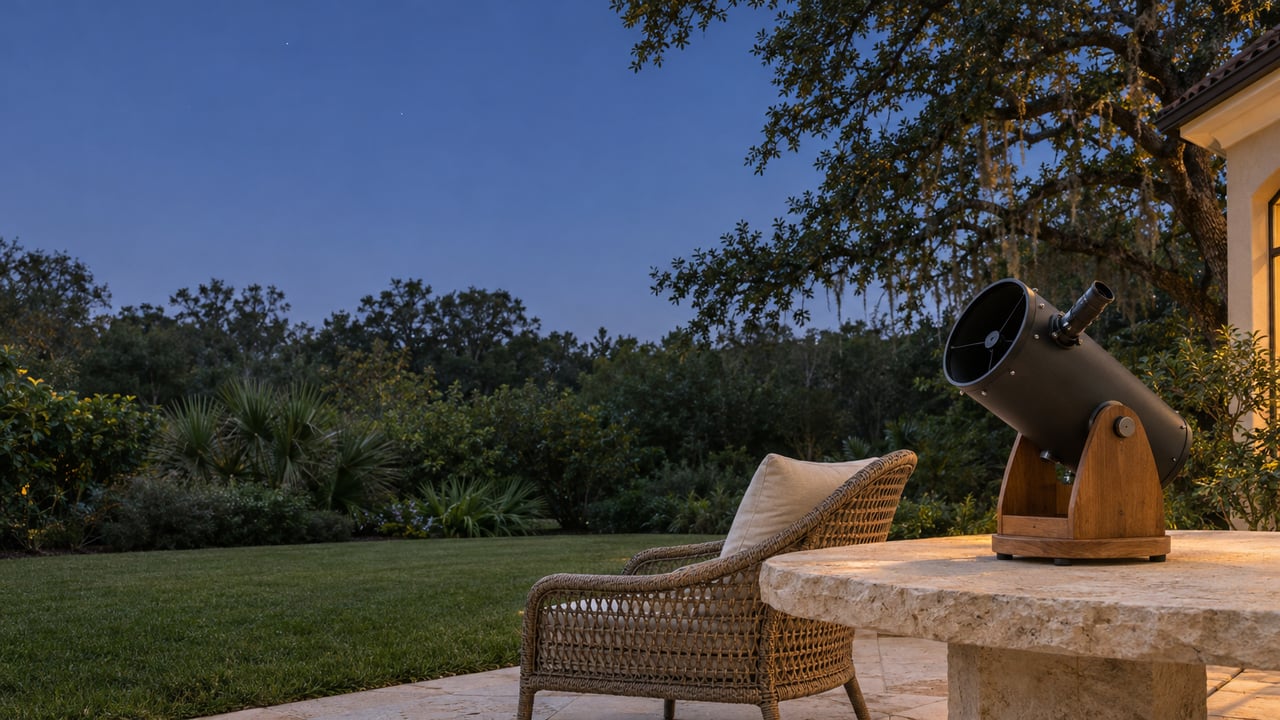
"These instruments allow families to transform their backyards into personal observatories." That line comes from Seminole County's Fall 2026 Leisure Guide. It introduces the fleet of telescopes the county library added to its new Library of Things, which opened to cardholders on Aug. 31, 2026.
On the Markham Woods Corridor, the backyard is where you'll actually use one. The weeks you have it are fixed and can't be extended, so the night sky decides when your hold should come in. For this winter, the answer is the first part of December.
What Comes in the Case
The kit is built around a Sky-Watcher Heritage 150P, a tabletop telescope. It needs a sturdy surface, like a patio table or a low wall, and it doesn't come with a tripod. The catalog record lists everything in the case:
- The telescope on its tabletop mount, plus an alt-azimuth base
- A 25mm wide-angle eyepiece and a 10mm eyepiece
- A red dot finder scope and a storage pouch for the lenses and finder
- A Phillips screwdriver, the instruction manual and a carrying case
- Two books: the National Geographic Backyard Guide to the Night Sky and 50 Things to See with a Telescope, a constellation guide written for kids and parents
The catalog puts the full kit's value at $415. The county guide names the targets it has in mind: the moon's craters, Saturn's rings and distant constellations. All of those depend on what the sky is doing during the weeks the case is in your house.
Two Weeks and No Renewals
WESH reported at the launch that Library of Things items check out for two weeks, the same way a book does. The county's Library of Things page lays out the process. You find the item in the online catalog, place a hold, pick it up once you're notified, and return it to a circulation desk by the due date. It also says there are no renewals. According to the Fall Leisure Guide, borrowers have to be 18 or older and show a Seminole County library card and a valid government-issued photo ID.
That matters because the moon changes a lot in two weeks. Florida's cloudy nights and school-night bedtimes shrink that time even further. A loan that lands during a bright full moon gives you a glaring white disk and washed-out stars. A loan that starts near a new moon gives you dark early evenings and a thin crescent that grows a little each night, with its craters sharpest along the line between light and shadow.
The telescope's catalog record lists its copies under the Central Branch in Casselberry. WESH also covered the collection's unveiling in Casselberry. The catalog shows availability live, so check the current status and the pickup branch before you count on a particular week. The hold you place in late November is what decides your December.
The December Window
Between the new moon on Dec. 8 and the full moon on Dec. 23, Orlando-area evenings start dark and the moon gets brighter each night. Several local and sky events fall inside that stretch.
| Date | What's happening | Where | Telescope or naked eye |
|---|---|---|---|
| Mon., Nov. 30, 6 to 7:30 p.m. | Skywatching Tips and Tricks with Professor Art Litka | North Branch Library, Sanford | Learn the kit before it arrives |
| Fri., Dec. 4, 8:30 p.m. | Central Florida Nights show | Emil Buehler Planetarium | Indoor show |
| Tue., Dec. 8 | New moon | Your backyard | Darkest evenings of the month begin |
| Sat., Dec. 12, 6 p.m. | Geneva Dark Sky Night | Seminole State's Geneva Center | Telescope viewing and constellation laser tours |
| Dec. 13 to 14 | Geminid meteor shower peak, moon 17% lit | Your backyard | Naked eye |
| Wed., Dec. 23 | Full moon | Your backyard | Moon at its brightest |
The American Meteor Society calls the 2026 Geminid conditions generally favorable, with a waxing crescent moon only 17% lit at the Dec. 13 to 14 peak. You watch meteors with your eyes, not through an eyepiece, so the telescope doesn't help with the shower. A December loan still covers both. The same week that brings a dark night for meteors also puts a young crescent moon in the early evening sky, which is a good fit for the kit's 25mm eyepiece.
Saturn shows up in the December evening twilight sky on the Abrams Planetarium December 2026 chart from Michigan State. That chart is drawn for 40 degrees north, which is well north of Lake Mary, so treat it as a rough guide for where to look.
Pick the kit up in the first week of December. With a two-week loan, a pickup around Dec. 5 to 7 covers the new moon, the Geneva event, the Geminid peak and a week of growing crescents, and the kit goes back before the full moon and the Christmas Eve closure.
Start in Sanford on Nov. 30
The Skywatching Tips and Tricks program is a free 90-minute evening at the North Branch, 150 N. Palmetto Ave. in Sanford. Professor Art Litka will cover the stars in the night sky and how to use a telescope to find and identify them. No registration is required, and the listing encourages attendees to ask about borrowing a telescope through the Library of Things.
It's a fairly long drive from the corridor. It's also the one evening on the calendar where you can learn how the kit works before your two weeks start, so your first clear night doesn't go to reading the manual by a red dot finder.
Why the Backyard and Not Wekiwa
Wekiwa Springs State Park is the corridor's big natural neighbor, and for stargazing it isn't an option. Florida State Parks says all state parks close at sunset. The park's own page also warns campers that construction may take place in the campground during their stay, limited to business hours. For a tabletop scope you set up after dinner, the practical spot is your own patio or lawn, ideally somewhere the tree canopy leaves an open patch of western sky, where the evening crescent moon sets.
For a night with experts and bigger telescopes, Seminole State's Emil Buehler Planetarium runs Geneva Dark Sky Nights at the college's Geneva Center. They're free, open to the public and need no reservations. The Dec. 12 session starts at 6 p.m. The planetarium's Telescope Thursdays run from October through March at different Central Florida locations, weather permitting, and dates are posted on its show and event calendar.
Getting the Kit In and Out Around the Holidays
The county library has three holiday closures between now and the new year: Nov. 26 and 27 for Thanksgiving, Dec. 24 and 25 for Christmas, and Jan. 1. Here's a calendar that works with them:
- Place the hold before Thanksgiving week. The Nov. 26 and 27 closures cut into the days before December, and the catalog shows where the kit is held right now.
- Know the branches on the west side of the county. The Northwest Branch is at 580 Green Way Blvd. in Lake Mary, and the West Branch is at 245 N. Hunt Club Blvd. in Longwood. Northwest is open Monday through Thursday 9 a.m. to 8 p.m., Friday and Saturday 9 a.m. to 5 p.m., and Sunday 1 to 5 p.m.
- Return to a circulation desk by the due date. There's no renewal option, and the county's library policies say overdue fines start the day after the due date.
- Keep January in mind if December fills up. The Quadrantid meteor shower peaks Jan. 3 to 4, 2027, under a waning crescent moon 16% lit, and the library reopens after the Jan. 1 closure.
The Library of Things is supported by the Seminole County Friends of the Library. Returning the kit on time keeps the hold line moving for the next family.
If you take the kit out to your Markham Woods yard this December, I'd love to hear what you saw, and I'm always happy to talk about which corners of the corridor have the widest-open skies. Reach out to Tara Mruk to schedule a free consultation, whether it's about stargazing in your own yard or about what your home on the corridor is worth.